Compound Interest Formula
FV = P (1 + r / n)Yn
where P is the starting principal, r is the annual interest rate, Y is the number of years invested, and n is the number of compounding periods per year.
FV is the future value, meaning the amount the principal grows to after Y years.
Understanding the Formula
Suppose you open an account that pays a guaranteed interest rate, compounded annually.
You make no further contributions; you just leave your money alone and let compound interest work its magic.
The balance your account has grown to at some point in the future is known as the future value of your starting principal.
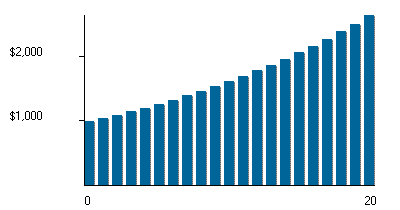
To find a formula for future value, we'll write P for your starting principal, and r for the rate of return expressed as a decimal.
(So if the interest rate is 5%, r equals .05).
Your balance will grow according to the following schedule:
| Year | Balance |
| Now | P |
| 1 | P + rP |
| 2 | (P + rP) + r(P + rP) |
This starts to get messy in a hurry.
But you can simplify it by noticing that you can keep pulling out factors of (1 + r) from each line.
If you do that, the balances collapse to a simple pattern:
| Year | Balance |
| Now | P |
| 1 | P(1 + r) |
| 2 | P(1 + r)2 |
If you follow this pattern out for Y years, you get the general formula for future value:
That's to compound once per year.
More generally, if you want to compound n times per year, you use:
Example
Let's say you want to invest $1000 at 5% interest, compounded annually. At the end of ten years, your balance would be
which equals $1628.89.
If the interest was compounded monthly instead of annually, you'd get
| |
FV = $1000 x (1 + .05/12)120
|
which equals $1647.01.
Philosophical Digression on Interest
At some point you should ask yourself why interest even exists - that is, why you can deposit money in a bank account and then earn more money without working.
The answer is that money is a useful thing, and interest is the rent that the bank pays to the money's owner (that's you) for the privilege of using it.
The typical way they'll use it is to rent it to somebody else, in the form of a mortgage or a car loan, for example.
As long as the rent they get is higher than the rent they pay you, all will be well.
As far as compound interest (earning "interest on your interest") - suppose you deposit $1000 in a bank account that pays five percent interest annually.
At the end of one year, your balance will have grown by $50 (that's five percent of your starting thousand) to $1050.
Assuming you leave the entire $1050 in your account, the interest you get during the next year will be greater - five percent of the entire $1050.
So compound interest is nothing mysterious; it's just a fixed rate of "rent" on your ever-growing principal.
(People like to say that Einstein thought compound interest was a fascinating concept.
Well... maybe someone named Al Einstein really did think that, but he wasn't the way-smart dude with the crazy hair.
Compound interest is nothing more than renting money.)
Another Digression, on Economics
In the middle of the Great Depression, John Maynard Keynes said "interest has been usually regarded as the reward of [saving], whereas in fact it is the reward of not-hoarding."
By "hoarding" he was referring to people's habit of hiding money in their mattresses instead of putting it in a bank account, out of fear that a bank failure could wipe out their savings.
Hoarding may have been intelligent behavior for individuals, but it was bad news for the economy because all that potentially useful money was being hidden where it could not be put to use.
Today, this problem has been solved: the FDIC insures bank accounts (up to a limit), making old-style hoarding obsolete.
The creation of the FDIC is an example of good government policy: it aligned people's personal goals (to keep their money safe) with the national economic interest (to keep the country's wealth available for productive use).
(Also see more compounding to compound interest periodically or continuously,
and basic investment for compound interest with annual additions,
plus the simple interest calculator.)
home |
article |
glossary |
calculator |
about us |
books
|